
Public data research · 2025 source data
Most older Florida movers had already been living in Florida
By RetirementRiskIQ · Published
This descriptive source-data research is separate from the site’s modeled risk scores. It does not estimate individual risk or provide personalized financial advice. Definitions, uncertainty and source-year limits are included below.
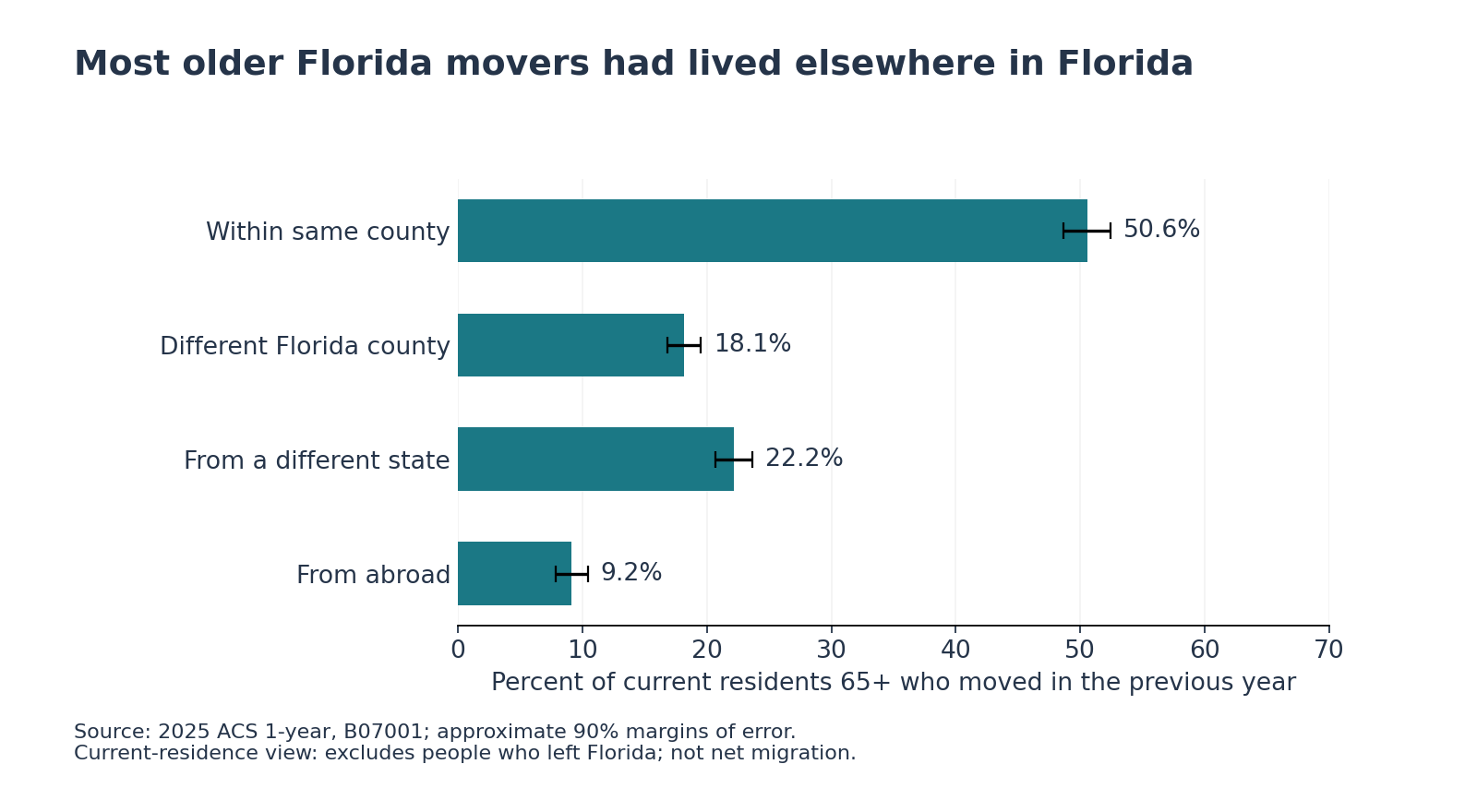
Sources, methods and downloadsThe familiar story of moving to Florida in later life captures only part of the movement among the state's older residents. In the 2025 American Community Survey, an estimated 68.7% of Florida residents ages 65 and older who had changed homes in the previous year had lived elsewhere in Florida.
That includes 50.6% who moved within the same county and 18.1% who moved from another Florida county. Another 22.2% had moved from a different state, and 9.2% from abroad. These are shares of current older residents who moved, not shares of all older Floridians. Source: Census Table B07001.
The largest group stayed in the same home
The survey estimates 5,351,132 Florida residents ages 65 and older. Of those, 4,979,622, or 93.1%, reported the same home one year earlier. The remaining 371,510 make up the mover denominator below. Each person appears in one of these previous-residence categories.
| Previous residence of movers | People 65 and older | Share of older movers |
|---|---|---|
| Same county | 187,803 ± 9,930 | 50.6% ± 1.9 percentage points |
| Different county in Florida | 67,408 ± 5,580 | 18.1% ± 1.3 percentage points |
| Different state | 82,304 ± 6,303 | 22.2% ± 1.5 percentage points |
| Abroad | 33,995 ± 4,887 | 9.2% ± 1.3 percentage points |
Rounding means the displayed percentages need not sum to exactly 100%. The combined within-Florida share is 68.7%, with an approximate 90% margin of error of 1.7 percentage points. It is comfortably above half, even allowing for that sampling uncertainty. The narrower same-county share, 50.6% ± 1.9 points, should not be described as a statistically established majority on its own.
These are current residents, not a net migration balance
The table begins with people living in Florida when surveyed and asks where they lived a year before. It does not include people who left Florida and now live elsewhere. It therefore cannot show whether the state gained or lost older residents through migration. Nor does it count every move made during the year: the survey compares residence at two points, rather than recording each address change.
The age category is measured at the survey date. It does not establish retirement status or the reason for a move. A same-county move could reflect many circumstances; this table does not identify downsizing, eviction, storm displacement, family care or a move to a particular type of housing.
Florida's wider growth story and residents' experiences with housing costs remain important reporting subjects. The data here add a specific distinction: movement among older Floridians is not synonymous with older newcomers arriving from other states. Local and within-state moves form the larger share of this particular current-resident mover population.
For reporting about housing transitions in later life, that suggests a useful line of inquiry inside existing communities as well as at the state border. It does not establish unmet demand, predict future moves or tell any household where it should live.
About this analysis
RetirementRiskIQ analyzed the 2025 American Community Survey 1-year detailed tables, downloaded November 2, 2026. These are survey estimates, not a census of every resident. Published margins of error and approximate derived margins use the 90% confidence level; aggregation and proportion calculations follow Census guidance and do not capture every nonsampling error. Census reports that a six-week suspension of 2025 collection affected sample size, response rates and margins of error; the published estimates are used without an invented correction. Read the collection note. Age categories do not establish retirement status. This article describes a population snapshot, not a RetirementRiskIQ risk score or personalized financial advice.
AI tools assisted the analysis code, drafting and checks. Source files, formulas, a claim ledger and chart-generation code accompany the article so another analyst can reproduce the results.
Sources, methods and downloads
The evidence archive contains frozen primary sources, their original hashes and offline calculation code for this site’s five November 2026 analyses. It preserves the source vintages and limitations described in each article.