
Public data research · 2025 source data
Older Oklahomans are a substantial part of grandparent responsibility
By RetirementRiskIQ · Published
This descriptive source-data research is separate from the site’s modeled risk scores. It does not estimate individual risk or provide personalized financial advice. Definitions, uncertainty and source-year limits are included below.
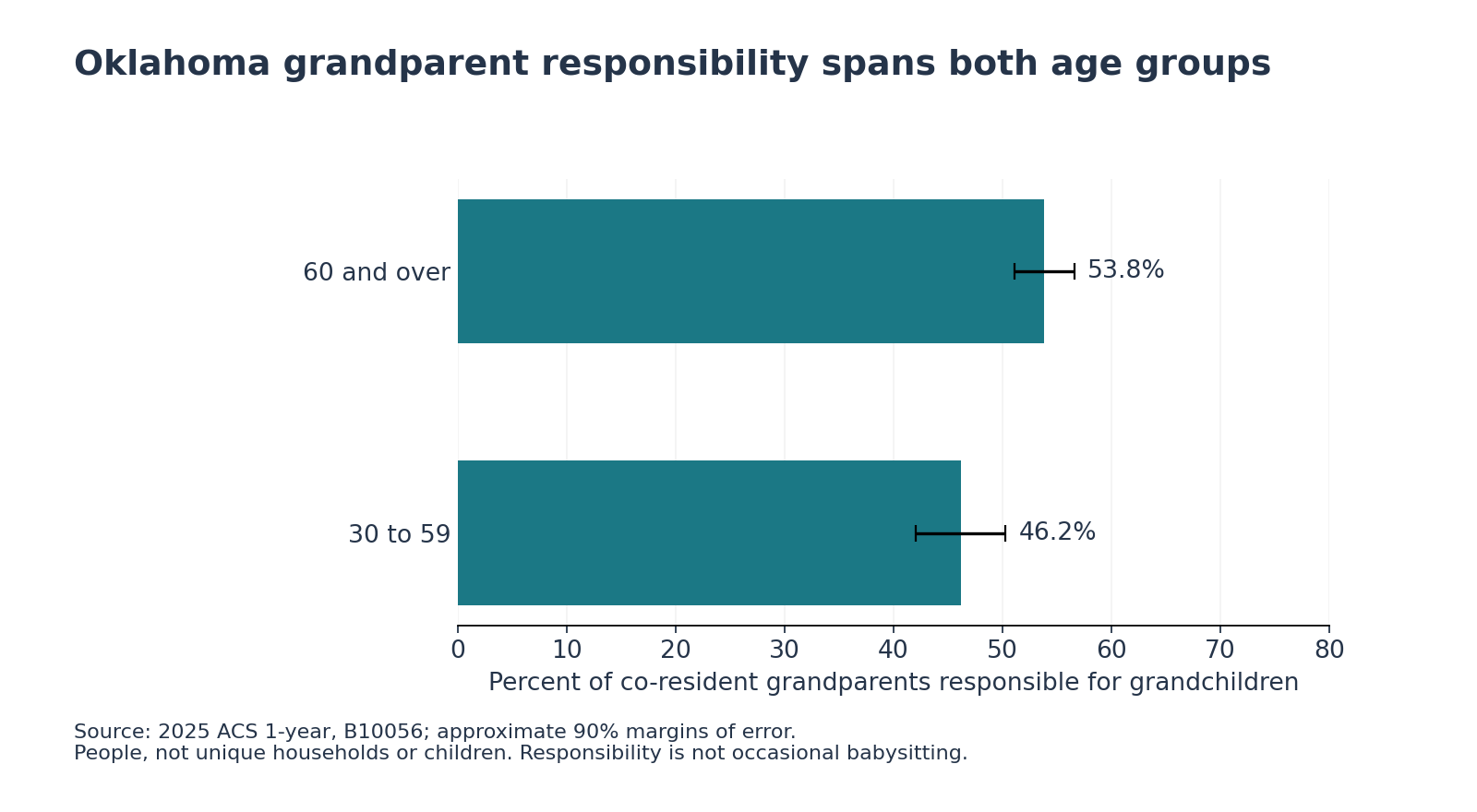
Sources, methods and downloadsAn estimated 19,088 Oklahoma grandparents ages 60 and older reported being responsible for the basic needs of grandchildren under 18 who lived with them in 2025. They represented 53.8% of the state's co-resident grandparents who reported that responsibility.
That is a measure of people carrying responsibility for grandchildren, not a count of children, unique families or occasional babysitters. The American Community Survey table estimates 35,457 responsible grandparents across the adult age groups it reports. The older group accounts for roughly half of that total.
Responsibility and sharing a home are separate questions
| Age of responsible grandparent | People | Share of responsible grandparents |
|---|---|---|
| 60 and older | 19,088 ± 1,974 | 53.8% ± 2.7 percentage points |
| 30 to 59 | 16,369 ± 2,074 | 46.2% ± 4.1 percentage points |
The complementary shares have different approximate margins because aggregation does not preserve all covariance; neither is used here to establish an older-group majority.
The survey's broader universe is grandparents living with their own grandchildren under 18. In Oklahoma, that total was 83,624. An estimated 42.4% reported responsibility for those grandchildren; others lived in the same home without reporting that role.
The questionnaire asks about responsibility for most basic needs, including food, shelter and clothing. That is a narrower concept than helping with childcare, and a different concept from legal custody. A grandparent can help substantially without meeting this survey definition, and responsibility does not establish whether a parent also lives in the household. Source: 2025 ACS questionnaire.
The count cannot be converted directly into households
Two responsible grandparents may live with the same children. Adding their responses counts two grandparents, not necessarily two caregiving households. Conversely, a grandparent may be responsible for more than one child. Neither the number of unique households nor the number of children can be recovered by simply relabeling the grandparent count.
The age cutoff also deserves care. This table groups ages 60 and older together. It does not isolate people ages 65 and older, identify retirees or show whether responsible grandparents are employed. The figures cannot be used to claim that a particular share of retired Oklahomans is raising grandchildren.
Oklahoma's older-group estimate includes 7,896 men and 11,192 women. Those are counts, not sex-specific rates of taking responsibility; the table does not supply the matching older male and female co-resident-grandparent denominators needed for that comparison.
These limits leave a clear finding: responsibility for the next generation is a substantial part of the state's older-grandparent picture. The count offers a starting point for reporting about how families arrange support and navigate services. It does not measure the cost of care, available income, health effects, eligibility for assistance or how much help a family receives.
The 2025 results are one cross section, not evidence that grandparent responsibility increased. Earlier journalism about relatives providing childcare is context for the subject, not proof that every family described there belongs in this survey category.
About this analysis
RetirementRiskIQ analyzed the 2025 American Community Survey 1-year detailed tables, downloaded November 2, 2026. These are survey estimates, not a census of every resident. Published margins of error and approximate derived margins use the 90% confidence level; aggregation and proportion calculations follow Census guidance and do not capture every nonsampling error. Census reports that a six-week suspension of 2025 collection affected sample size, response rates and margins of error; the published estimates are used without an invented correction. Read the collection note. Age categories do not establish retirement status. This article describes a population snapshot, not a RetirementRiskIQ risk score or personalized financial advice.
AI tools assisted the analysis code, drafting and checks. Source files, formulas, a claim ledger and chart-generation code accompany the article so another analyst can reproduce the results.
Sources, methods and downloads
The evidence archive contains frozen primary sources, their original hashes and offline calculation code for this site’s five November 2026 analyses. It preserves the source vintages and limitations described in each article.